Zombies, Vampires, and Philosophy by Richard Greene
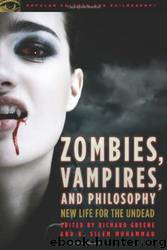
Author:Richard Greene
Language: eng
Format: epub
Publisher: Open Court
Published: 2010-06-08T16:00:00+00:00
13
Deserving to Be a Vampire: The Ethical and Existential Elements of Vampirism
TED M. PRESTON
I was once paid an extraordinary compliment: “Ted, I can’t say this about many people, but I think you would make a great vampire.” I swelled with pride. Vampires are powerful, mysterious, immortal, and sexy (just review the vampire “headquarters” in the film, Underworld, if you have any doubts). I have sometimes found myself daydreaming about what it would be like to be a vampire. In my daydreams, it’s always good (though I’d have to teach only evening classes if I wanted to continue in my current profession). But (and here the “professional philosopher” bares his fangs), upon reflection, I have to wonder, would it truly be good to be a vampire? Morally good? Desirable?
If there’s something immoral about vampirism, and if being a good person is of some importance to me—shouldn’t that give me an overriding reason to reject vampirism (in the fantastic and fictional scenario in which it’s offered), no matter how super-naturally sexy I might become?
It’s often assumed that vampires are evil by their very nature. There’s a strong and immediate objection to vampirism from within a Christian perspective. If Jesus of Nazareth is “the Way, the Truth, and the Life,” and the only legitimate source of eternal life, then any alternative route to immortality could easily be regarded as rebellion against God. Indeed, many of the stereotypical weaknesses of vampires depend upon this perception that they have somehow rebelled against God. Consider their aversion to crosses, their “allergy” to holy water, and so on. Indeed, in the film Dracula 2000, this notion of rebellion is expressed by making Dracula’s true identity none other than Judas Iscariot (the betrayer of Jesus) himself.
But not everyone agrees with the explicit and implicit claims and assumptions of Christianity. If our sole concern with respect to vampirism is that it’s “sinful,” then anyone who can’t appreciate or take seriously the notion of sin (or at least sin within that particular religious context) will already be alienated from our investigation. Accordingly, I will focus on the concerns potentially arising from vampirism in a way that doesn’t rely on any overt theological assumptions.
Download
This site does not store any files on its server. We only index and link to content provided by other sites. Please contact the content providers to delete copyright contents if any and email us, we'll remove relevant links or contents immediately.
| Anthropology | Archaeology |
| Philosophy | Politics & Government |
| Social Sciences | Sociology |
| Women's Studies |
The remains of the day by Kazuo Ishiguro(9000)
Tools of Titans by Timothy Ferriss(8398)
Giovanni's Room by James Baldwin(7347)
The Black Swan by Nassim Nicholas Taleb(7132)
Inner Engineering: A Yogi's Guide to Joy by Sadhguru(6797)
The Way of Zen by Alan W. Watts(6615)
The Power of Now: A Guide to Spiritual Enlightenment by Eckhart Tolle(5785)
Asking the Right Questions: A Guide to Critical Thinking by M. Neil Browne & Stuart M. Keeley(5776)
The Six Wives Of Henry VIII (WOMEN IN HISTORY) by Fraser Antonia(5516)
Astrophysics for People in a Hurry by Neil DeGrasse Tyson(5191)
Housekeeping by Marilynne Robinson(4449)
12 Rules for Life by Jordan B. Peterson(4307)
Ikigai by Héctor García & Francesc Miralles(4275)
Double Down (Diary of a Wimpy Kid Book 11) by Jeff Kinney(4273)
The Ethical Slut by Janet W. Hardy(4258)
Skin in the Game by Nassim Nicholas Taleb(4250)
The Art of Happiness by The Dalai Lama(4131)
Skin in the Game: Hidden Asymmetries in Daily Life by Nassim Nicholas Taleb(4007)
Walking by Henry David Thoreau(3963)
